
This latest blog has been written by Carys Mainprize, Education Programme Lead at the Crichton Carbon Centre.
Although not currently a core focus of SCAMP, seaweeds are iconic and fundamental to the coastal landscape and experience. I have fond memories of windswept Caithnessian beaches with long (stinky, slimy) seaweed washed ashore, perfect for various imaginary games or to toss for the dogs to chase. That was largely where my interest started and ended at the time, but throughout the years I’ve become slowly and vaguely aware of seaweed harvesting and growing, which consolidated into something resembling actual knowledge when the SCAMP team visited SAMS and we received a tour of their seaweed labs.
(perhaps SCAMP has a photo of the labs they can put here?)
For SCAMP, the Crichton Carbon Centre is creating a series of dynamic and innovative lessons for secondary school pupils. We’ve already written about our giant sea urchin prop (link: https://www.solwaycoastmarine.co.uk/the-sea-urchin-story-blog-by-crichton-carbon-centre/). Today, we’ll talk about developing a game around sustainable businesses.
Since the young people are the entrepreneurs of the future, I wanted the opportunity to talk about sustainability in businesses and – potentially – even introduce the idea that businesses can, and should, be sustainable.
The game needed to be based around the sustainable development goals, which while may seem unlikely for humanity to collectively achieve by 2030, remain a great visual and conceptual tool to what sustainability is in concrete reality. Yes, everyone should have clean water, but how does your life/business/actions contribute (or not) to that goal?
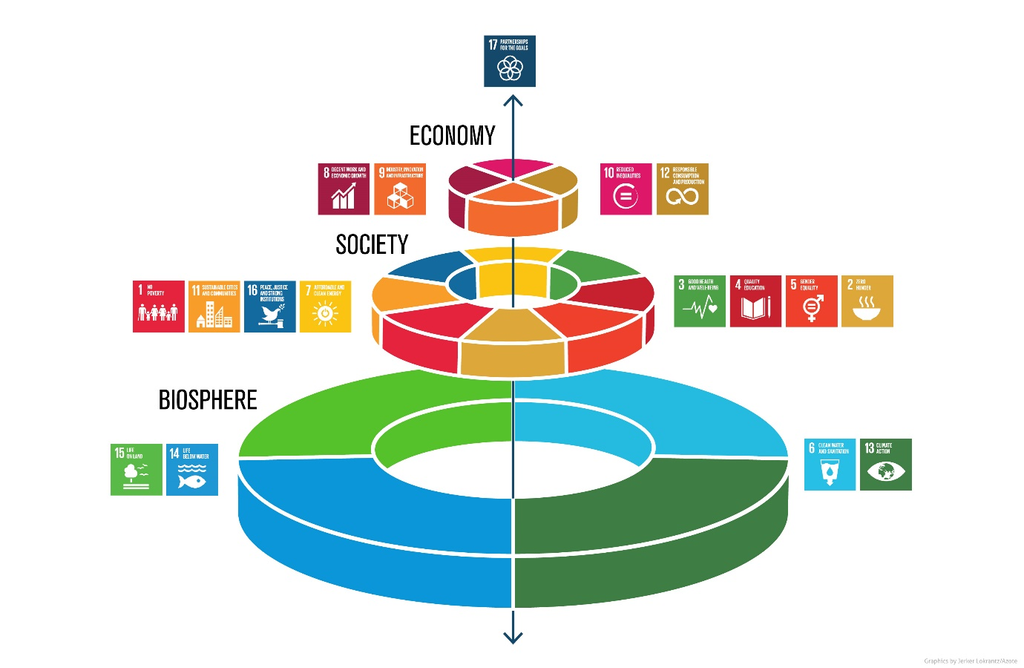
I had the particular vision in mind of the three tiered circles containing the goals, sorted into categories of people, planet, and prosperity. Three is a good number to focus both in games and elsewhere; it’s easy to remember three things, and to keep track.
However, I also wanted to introduce the concept of the doughnut economy (link:https://doughnuteconomics.org/) to the game. This gives an element of challenge that makes the game into a game: you must try to develop enough to provide humanity with all we need, but not overdevelop beyond what the earth can handle.
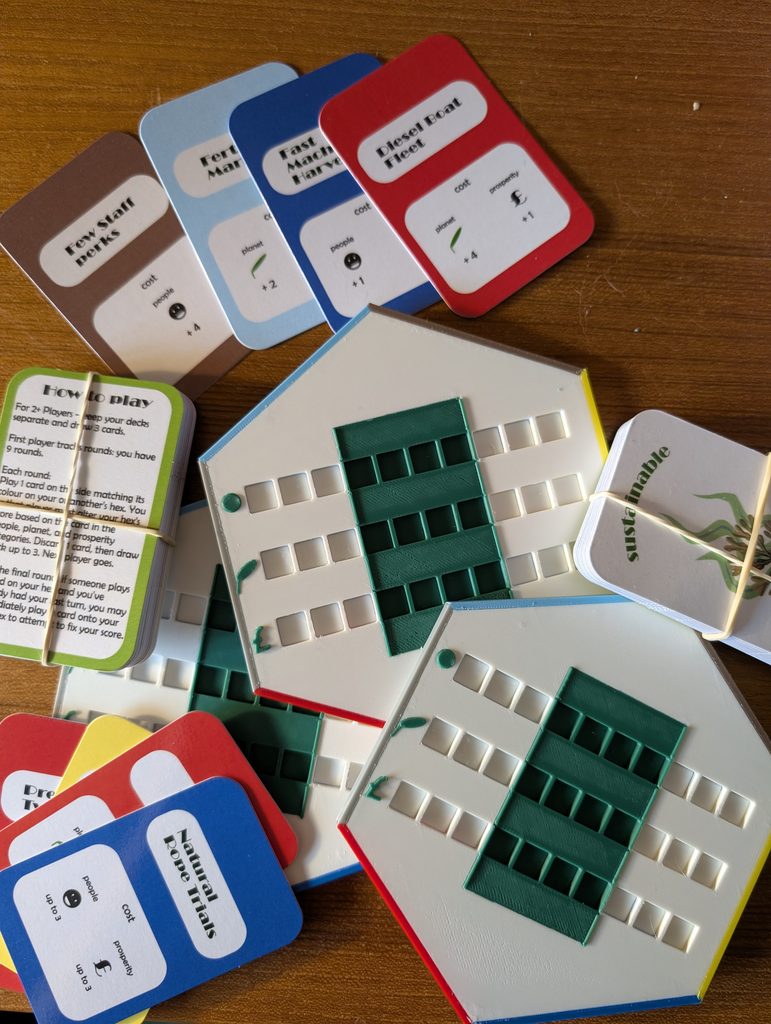
Then, naturally, players need a way to score points and manage their development that should be a simplified look at what running a business is. I already had an idea for a hexagonal 3D printed game tile in mind, and so I decided on six categories: site, product, management, policies, input, and innovation.
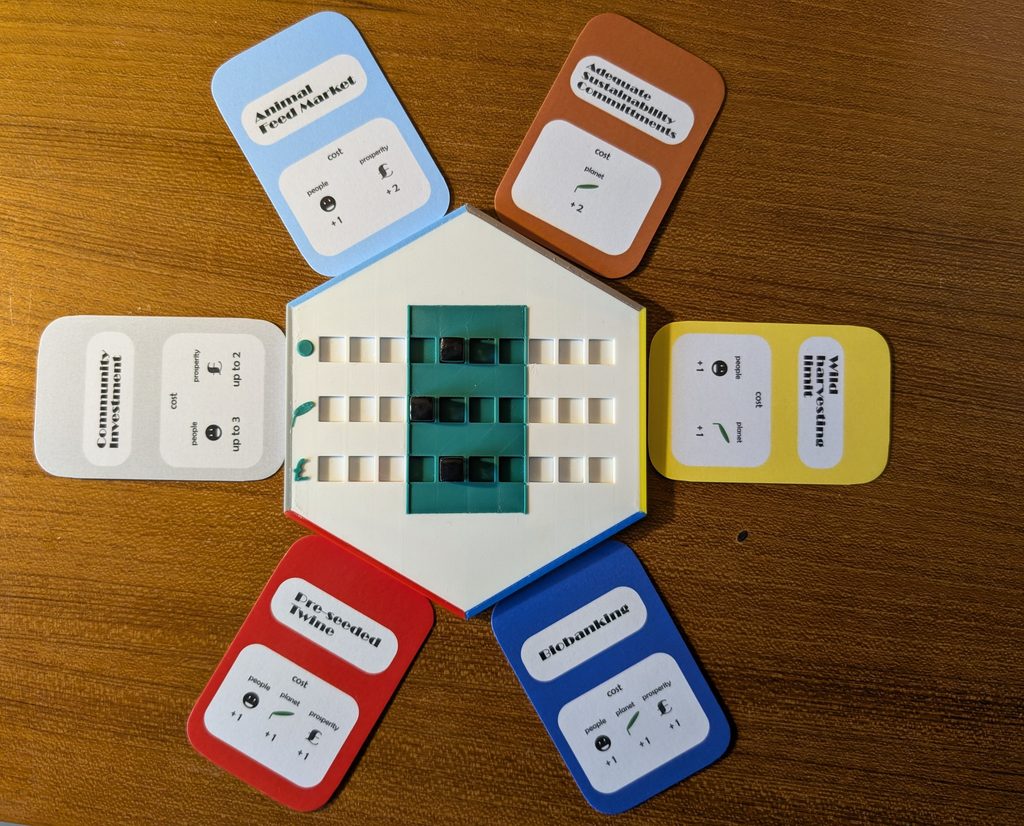
Cards can be played in these categories to score points along the three tracks, and players had to carefully choose the cards – but businesses don’t exist in isolation, so 2 or more players can play together (so long as they each have a game tile and deck) and play cards on each other’s hexes too. Whether players decide to collaborate or compete will be up to them – and potentially a good teaching moment when pupils reflect on the game afterwards.
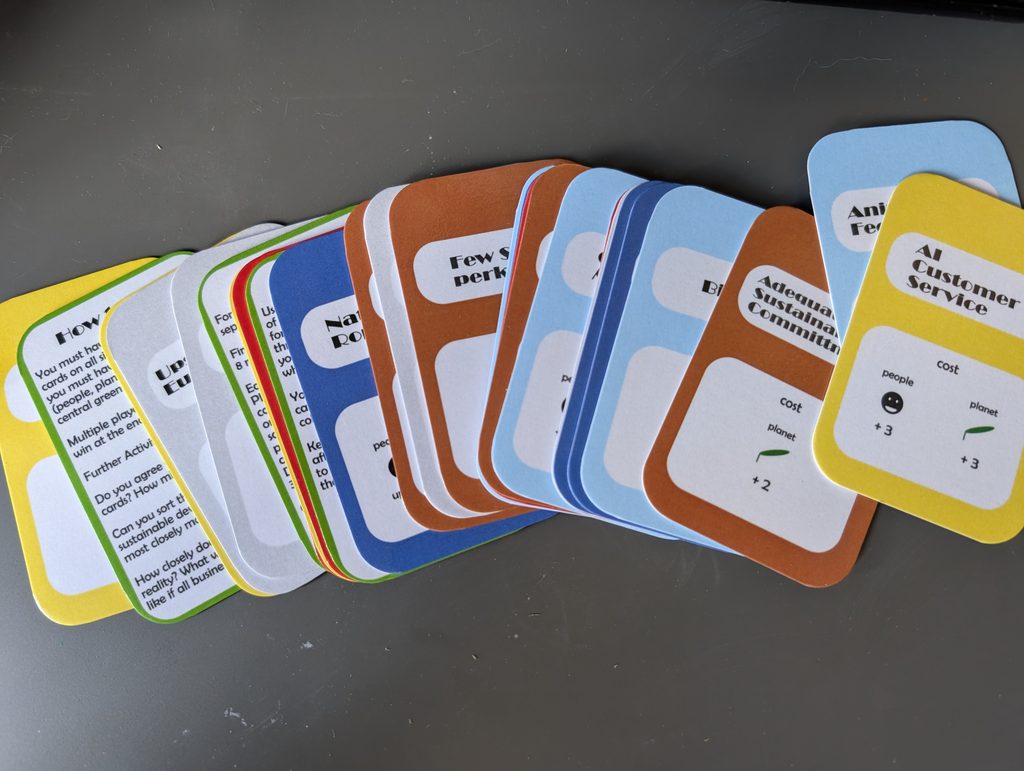
The sustainable business in question was to be seaweeds. Now, one of SCAMP’s key focuses is on Oyster Reefs, and we do of course have the Loch Ryan Oyster Fishery in Dumfries and Galloway which is a sustainably managed reef, but after some back and forth I decided that seaweeds were more widely recognised by young people, but that it was less likely that they knew of seaweed harvesting and farming as a business and potential market. Plus, I will focus on oysters during another lesson.
With a helpful chat from Leigh from Aird Fada (link: https://swmid.co.uk/our-projects/aird-fada-seaweed-farm/), I made sure the game cards were reflective to the realities of seaweed businesses as much as possible within the frame of the game (for example, UK seaweeds don’t tend to become biofuel, but I needed a product that was a bit more of a sustainability bad guy (because the sequestered carbon is released upon burning)). As part of the conversations I had with others, I chatted with RUBISKO (link: https://www.rubisko.co.uk/) who are also looking into seaweed education (and have a kickstarter up for a beautifully illustrated seaweed card deck).
I taught myself some basic 3D modelling, created some simple cards, ordered a few samples and prepared for a playtest.
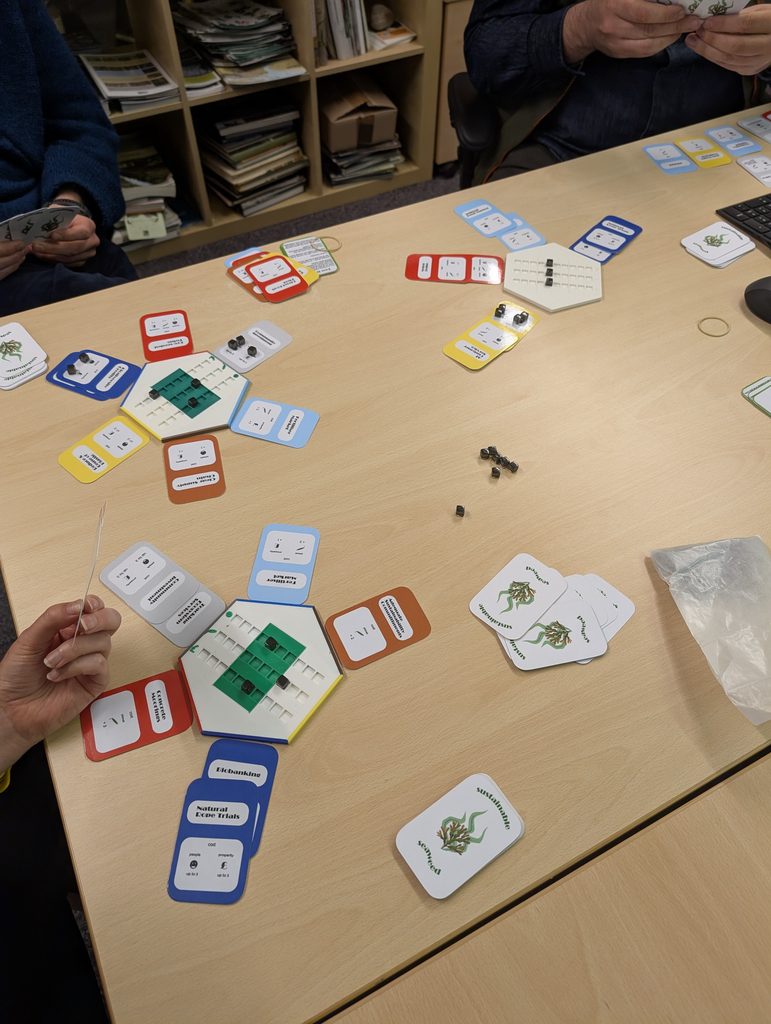
I’m so pleased with the finished game and how easily it can be adapted to other businesses with a few card title tweaks, and how a few additional cards could give secret agendas and really reflect why people might choose not to make a sustainable business (if your agenda is to be the highest scorer on the prosperity track in the room, you won’t care about people and planet, will you?)
The development of this game was support by the National Lottery Heritage Fund and lottery players.
If anyone would like to find out more about the game, contact Carys at c.mainprize@carboncentre.org
