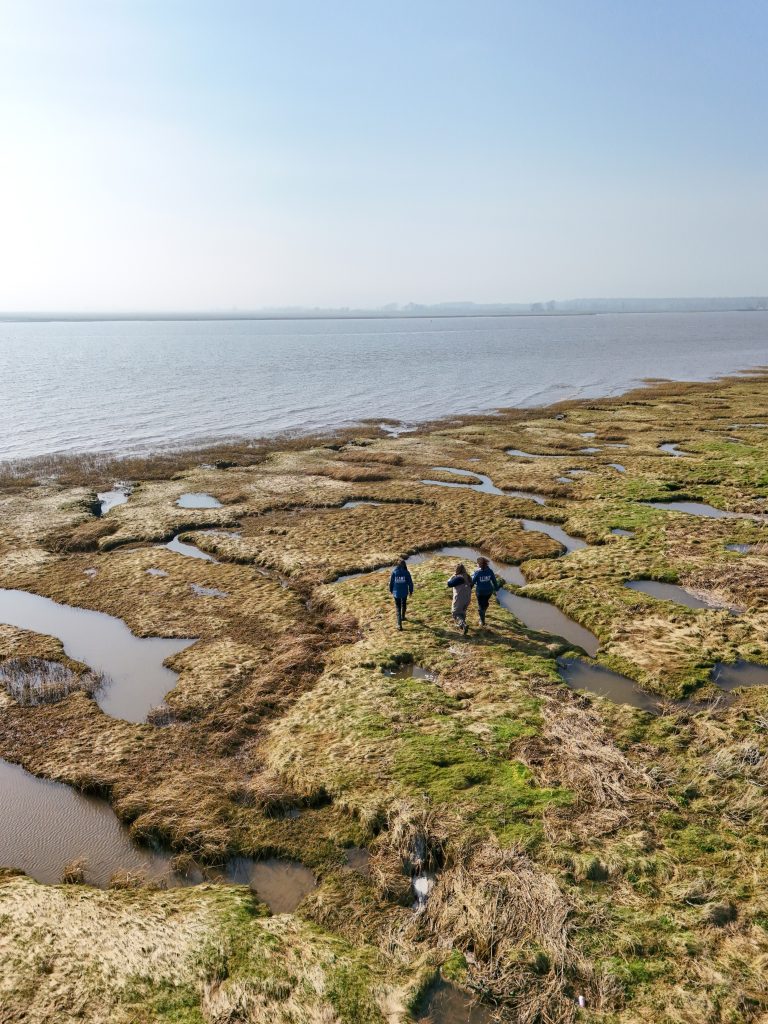
Saltmarsh

A saltmarsh is a harsh and testing environment for life. Inundated by seawater twice a day, it is a challenging home for species that need to breath air and species that need to be aquatic. The plants that grow here must be tolerant of salt. Aquatic animals need to be able to enter the marsh as the tide makes and leave as it recedes, or risk becoming stranded; terrestrial animals must do the same, in reverse.
For all the harshness of the environment, there are rewards for those who can cope. Energy rich sediments get deposited on each tide, providing food for highly specialised plant species that can live nowhere else. Invertebrates that can cope with the conditions thrive in vast numbers. A healthy saltmarsh supports large numbers of juvenile fish who enter with the tide and depart as the waters leave.
Huge flocks of migratory birds take advantage of the marsh’s bounty every winter. Waders gorge on invertebrates and geese graze the wiry grasses, storing up fat for their spring migrations back to their breeding grounds in the Arctic.
Over 25% of Scotland’s saltmarsh is found on the Solway, where it is locally known as merse. For humans the merse is a protector, absorbing damaging waves from storms and protecting our communities inland. Other saltmarsh superpowers include purifying water and helping mitigate the impact of climate change.
The Crichton Carbon Centre’s Wetlands and Landscape Lead, Lauren Parry, is involved in SCAMP’s Cairn to Coast project. She says:
“The health of the Solway’s coastal environments is closely linked to Dumfries and Galloway’s landscape. Cairn to Coast will investigate connections between land habitats – such as woodlands, pasture and peatlands – and sensitive habitats along the coast. Working with partners, we aim to identify how improved water management can support and enhance these unique coastal environments.”
The Crichton Carbon Centre’s Wetlands and Landscape Lead, Lauren Parry, is involved in SCAMP’s Cairn to Coast project. She says:
“The health of the Solway’s coastal environments is closely linked to Dumfries and Galloway’s landscape. Cairn to Coast will investigate connections between land habitats – such as woodlands, pasture and peatlands – and sensitive habitats along the coast. Working with partners, we aim to identify how improved water management can support and enhance these unique coastal environments.”
Sadly the RSPB explains that the UK has lost 85% of its saltmarsh since 1860.